Keep the RevenueCat SDK
Set one proxy URL. Offerings, purchases, restores and CustomerInfo code stays as it is, and so do your webhooks and REST calls.
RevenueCat alternative
The best open-source RevenueCat alternative is RevenueDot. It is an AGPL-3.0 backend that the stock RevenueCat SDKs already talk to, so you change one URL and keep your app code. Use RevenueDot Cloud, free up to $10K a month, or self-host with Docker and Postgres. It has no SOC 2 report and no years of live traffic yet. For a hosted option with a different SDK, look at Adapty, Qonversion or Superwall.
Prefer your own servers? Self-host free · See every alternative
Purchases.proxyURL = URL(string: "https://api.revenuedot.app")!  // or your own server
Purchases.configure(withAPIKey: "appl_...")                       // unchanged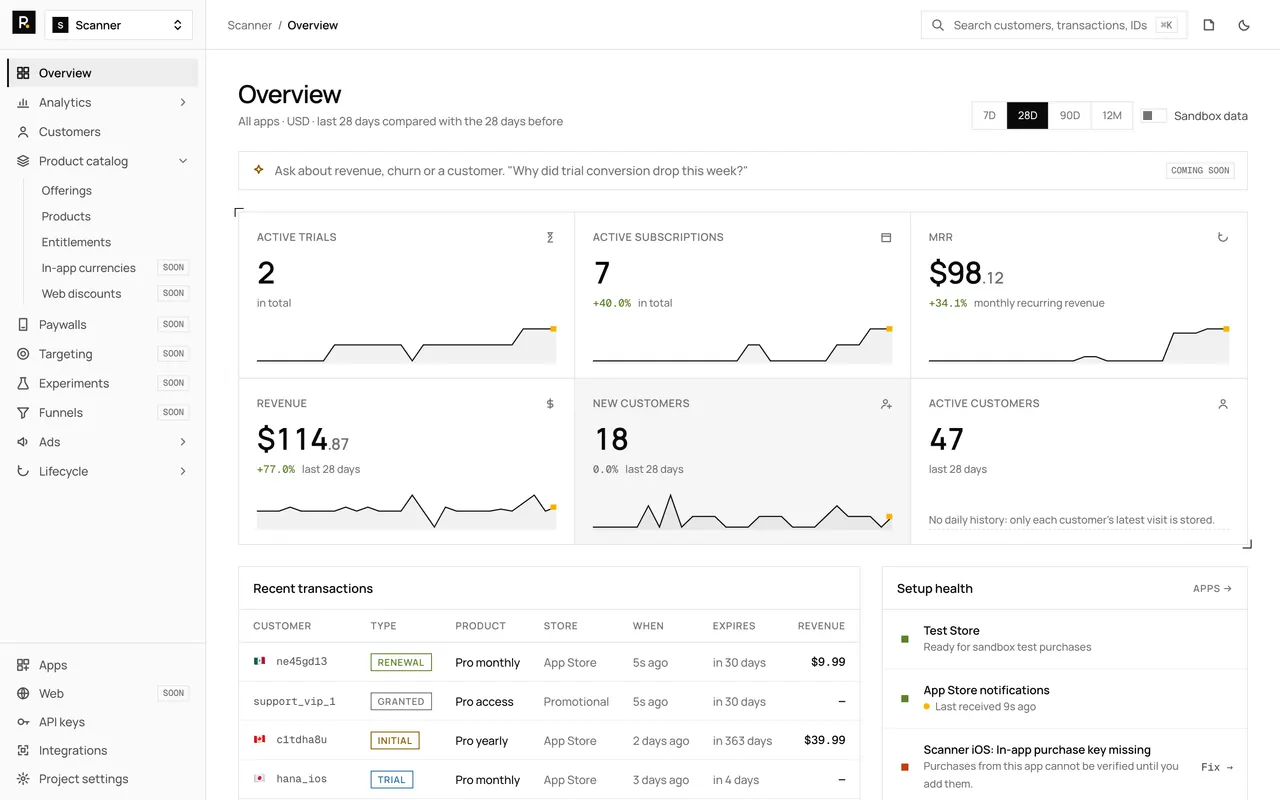
Set one proxy URL. Offerings, purchases, restores and CustomerInfo code stays as it is, and so do your webhooks and REST calls.
RevenueCat charges 1% of all tracked revenue from $2,500. RevenueDot Cloud is free to $10K, with a planned cap of $999 a month above that.
Run the AGPL-3.0 server on your own infrastructure. Receipts, customers and purchase history live in your own database, with no revenue share.
43 charts, paywalls with a visual editor, experiments, web checkout, 36 integrations, Refund Control and win-back, in one dashboard.
Three reasons come up again and again: the bill, who owns the data, and how hard it is to leave.
RevenueDot is a server that answers the same API the RevenueCat SDKs call, so your app keeps the SDK and talks to a different host. The SDKs have a proxy URL setting built for this. RevenueDot also publishes hard forks of all ten SDKs that default to its host and verify its response signatures.
// Before Purchases.configure
Purchases.proxyURL = URL(string: "https://api.revenuedot.app")!
Purchases.configure(withAPIKey: "appl_...")
Migration
The work is an import, a side-by-side run and a release. The app change is one line.
Create a free Cloud account, then run npx revenuedot import --from-revenuecat with a read-only RevenueCat secret key. It copies apps, SDK keys, products, offerings, customers and history. Use --dry-run first.
Point App Store and Google Play server notifications at RevenueDot, which forwards each one to RevenueCat so both stay current.
Set the proxy URL in your next release, watch the dashboard fill, and turn RevenueCat off when most active users have updated.
FAQ
RevenueDot. Its server and dashboard are AGPL-3.0, its SDK forks are MIT, and it works with the stock RevenueCat SDKs, so you keep your app code. It runs on RevenueDot Cloud, free up to $10,000 a month, or on your own servers. It is newer than RevenueCat and has no SOC 2 report yet.
No. RevenueCat's service runs only in RevenueCat's cloud; only its SDKs are open source. To self-host in-app purchase infrastructure that works with the RevenueCat SDK, run RevenueDot with Docker and Postgres on your own servers.
Yes. RevenueDot Cloud is free up to $10,000 of monthly tracked revenue, and self-hosting is free with no limit, under AGPL-3.0. Superwall also offers free subscription infrastructure and bills 1% only on revenue from its own paywalls above $10K a month.
With RevenueDot, one line: set the SDK's proxy URL before configure. With the stock SDK you also turn off its response-signature check, or you use a RevenueDot SDK fork. With Adapty, Qonversion, Superwall or Apphud you replace the SDK and rewrite your purchase code.
Import your project with a read-only RevenueCat key, which copies customers, entitlements and history. Then point store notifications at RevenueDot, which forwards them to RevenueCat so both stay current, and ship the proxy change. Current access is imported, so no subscriber loses access on switch day.
Not yet proven. RevenueCat has years of live purchase traffic and a SOC 2 Type II report. RevenueDot launched in 2026. Running both side by side during a migration lets you compare them before you switch.
Get started
Start free on RevenueDot Cloud, free up to $10,000 a month in tracked revenue, or move an existing RevenueCat app with one line of code.
Already have an account? Sign in · Prefer your own servers? Self-host free